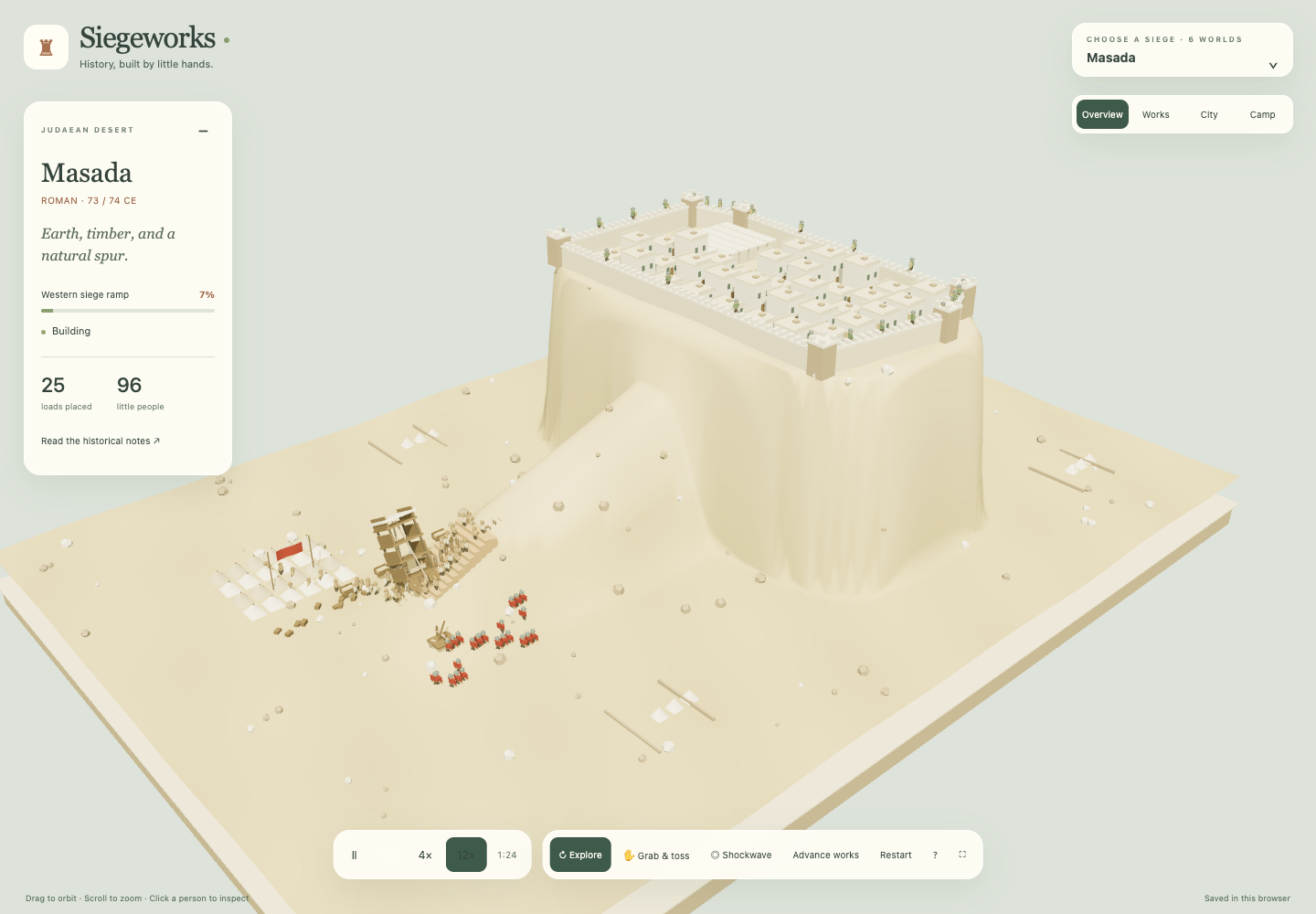
Roman / 73 / 74 CE
Masada
Watch a supply line build an earthen approach over the western spur. When the surface is ready, a timber tower can climb toward the casemate wall.

ROMAN / JUDAEA / 70 CE
Work crews build approach terraces beneath the northern defenses. Towers and artillery support an assault against several walls around a dense urban model.
Play the Jerusalem siege simulation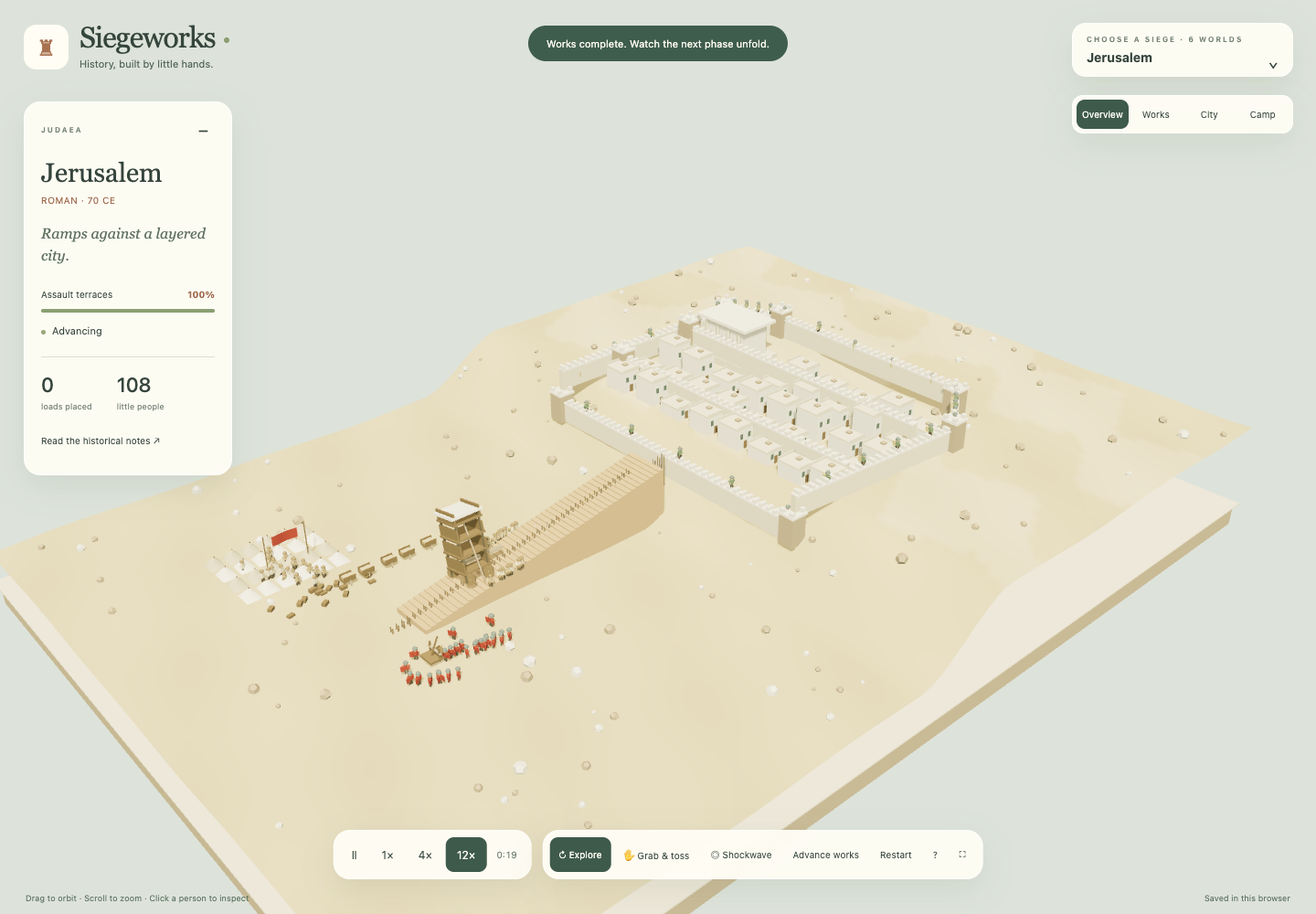
Start at the supply camp and follow workers carrying material toward the assault approach. The terrain rises into a city with successive walls and closely packed buildings.
The tower moves only when the approach is ready. Watch projectiles under gravity and inspect how the front wall responds to repeated impacts.
The city and monumental buildings are schematic. Read the historical sources alongside the model, especially when comparing the scene with Josephus’s narrative.
Roman forces under Titus besieged Jerusalem in 70 CE. Josephus describes siege banks, engines, successive walls, and assaults during the siege.
This is a schematic engineering vignette, not a surveyed reconstruction of Jerusalem or a complete account of the siege. Buildings, banks, and positions are simplified; the destruction of civilians is not simulated.
Three.js renders the scene, while cannon-es handles dynamic bodies, gravity, collisions, pickup constraints, and projectiles. Workers follow local job routines. Siege engines and ships use controlled movement. This is a playable engineering visualization, not an archaeological survey or a calibrated battle model.
Construction begins automatically. Choose Overview, Works, City, or Camp to move closer. Drag to orbit and scroll or pinch to zoom. Click a person to inspect their job, then choose Follow this person if you want to stay with them.
Grab & toss lifts workers and soldiers. Release slowly to drop or flick to throw. Shockwave knocks nearby people off balance. Space pauses; 1×, 4×, and 12× change the simulation speed. Advance works moves you to the later phase. Progress is saved separately for each siege in this browser.
Open JerusalemThese links support the historical context. The miniature’s geometry, agents, and physical parameters are original simplified implementations.
Roman / 73 / 74 CE
Watch a supply line build an earthen approach over the western spur. When the surface is ready, a timber tower can climb toward the casemate wall.
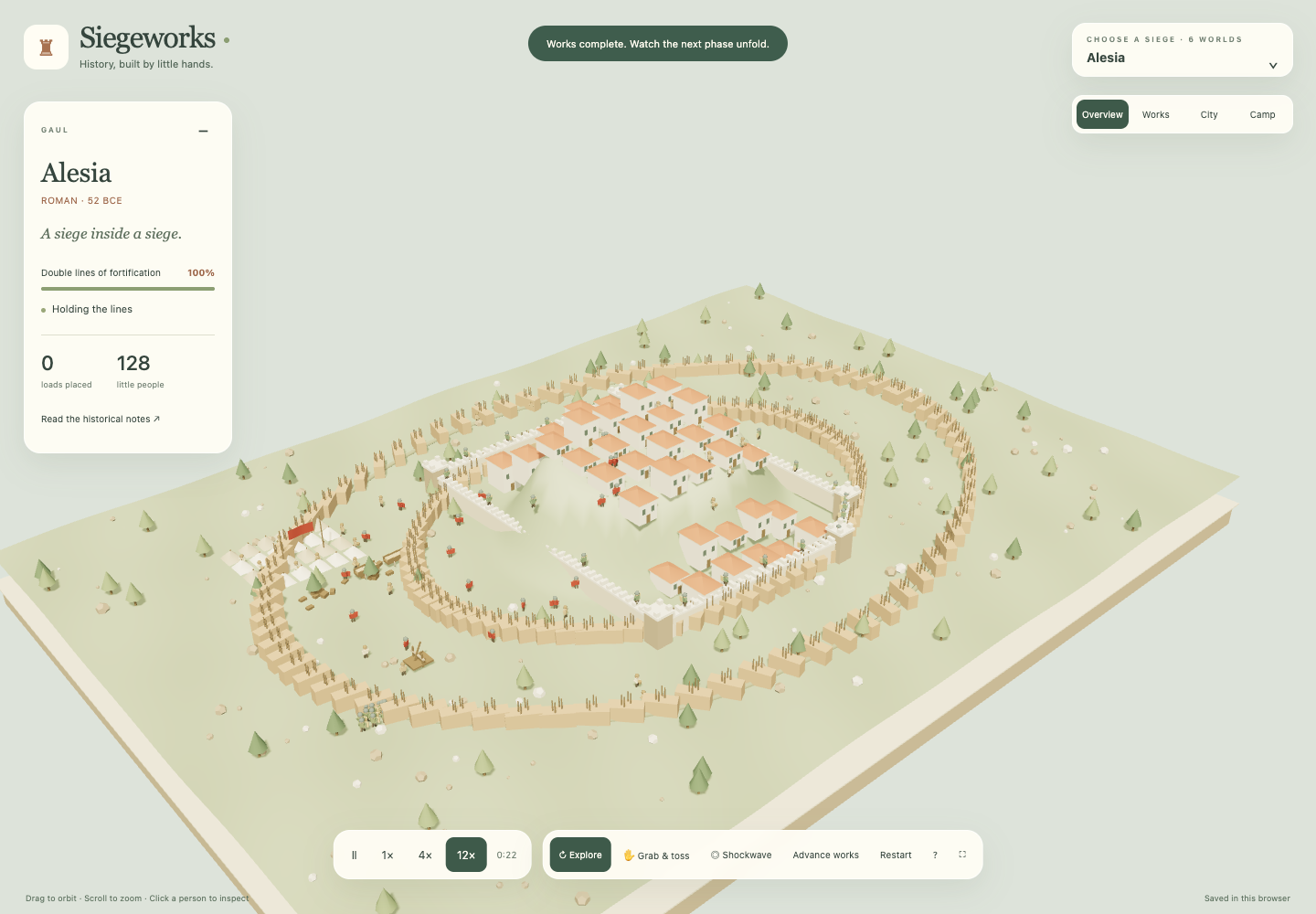
Roman / 52 BCE
Builders extend two defensive circuits around the hilltop settlement. Roman patrols hold the space between them while a relief force approaches from outside.
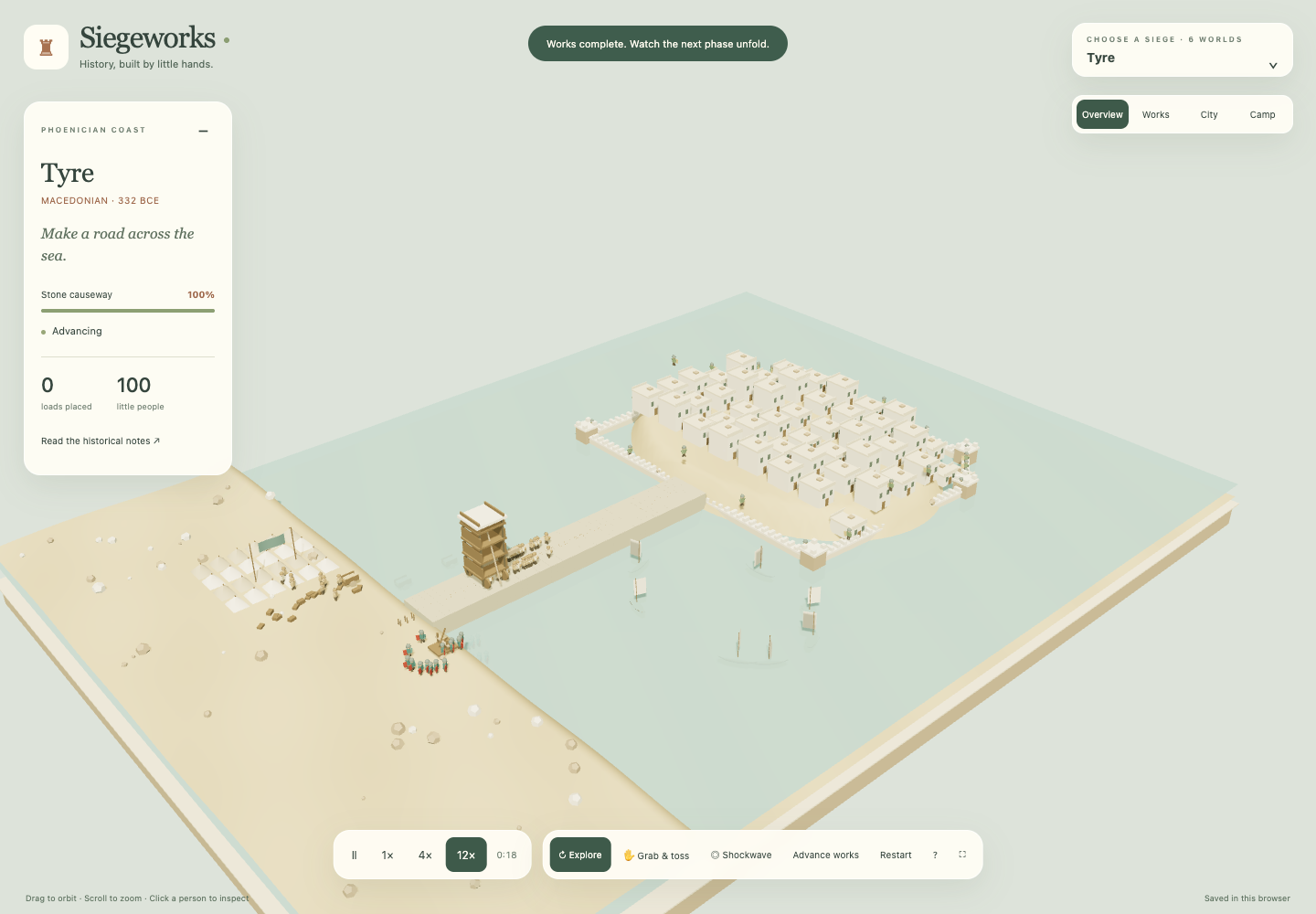
Macedonian / 332 BCE
Haulers carry rubble from the shore and extend a causeway toward an island city. Ships circle the works and towers advance as the stone surface emerges from the water.
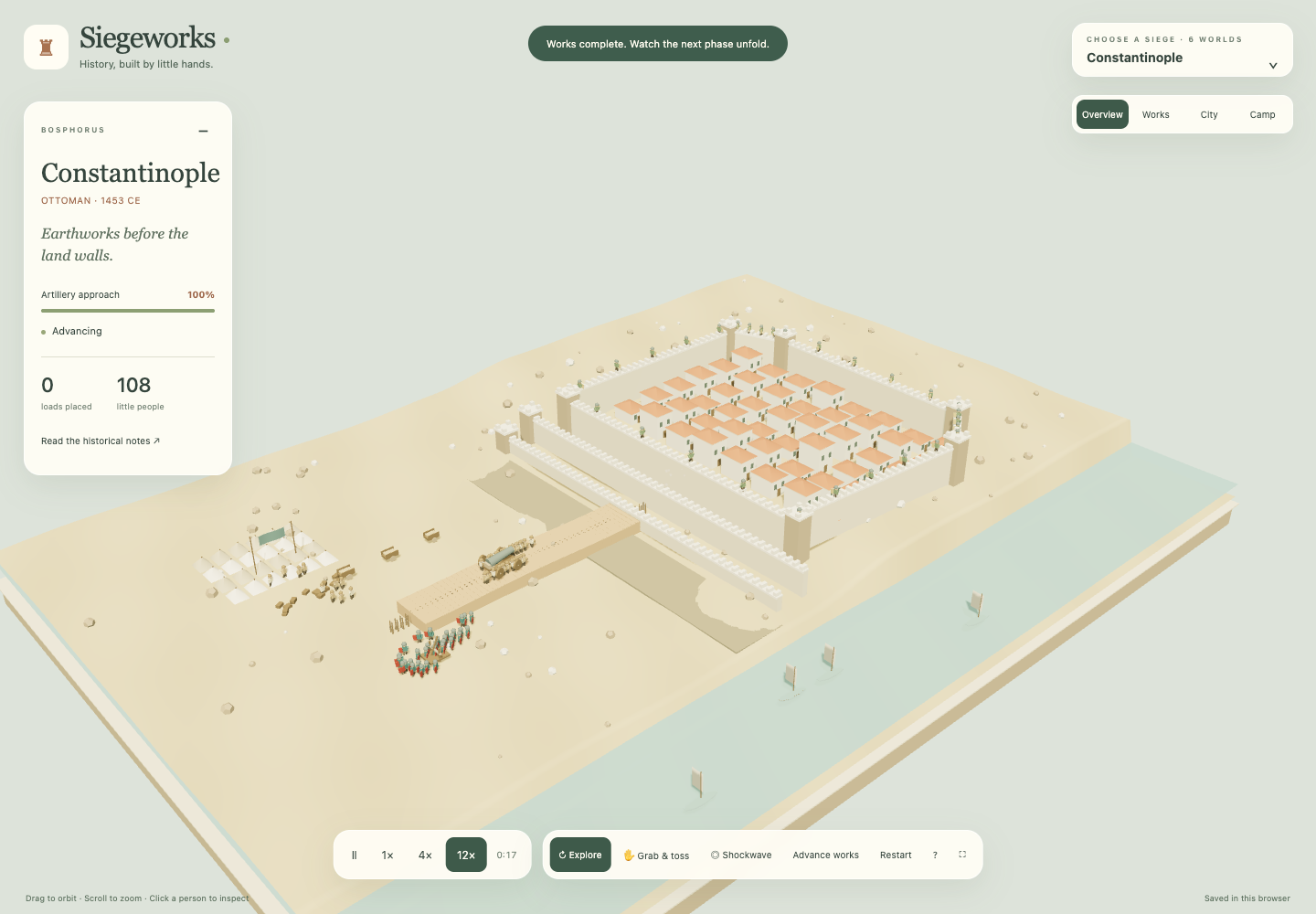
Ottoman / 1453 CE
Crews prepare protected gun positions and bring ammunition forward. Heavy cannon fire physical projectiles toward a miniature section of the layered land walls.
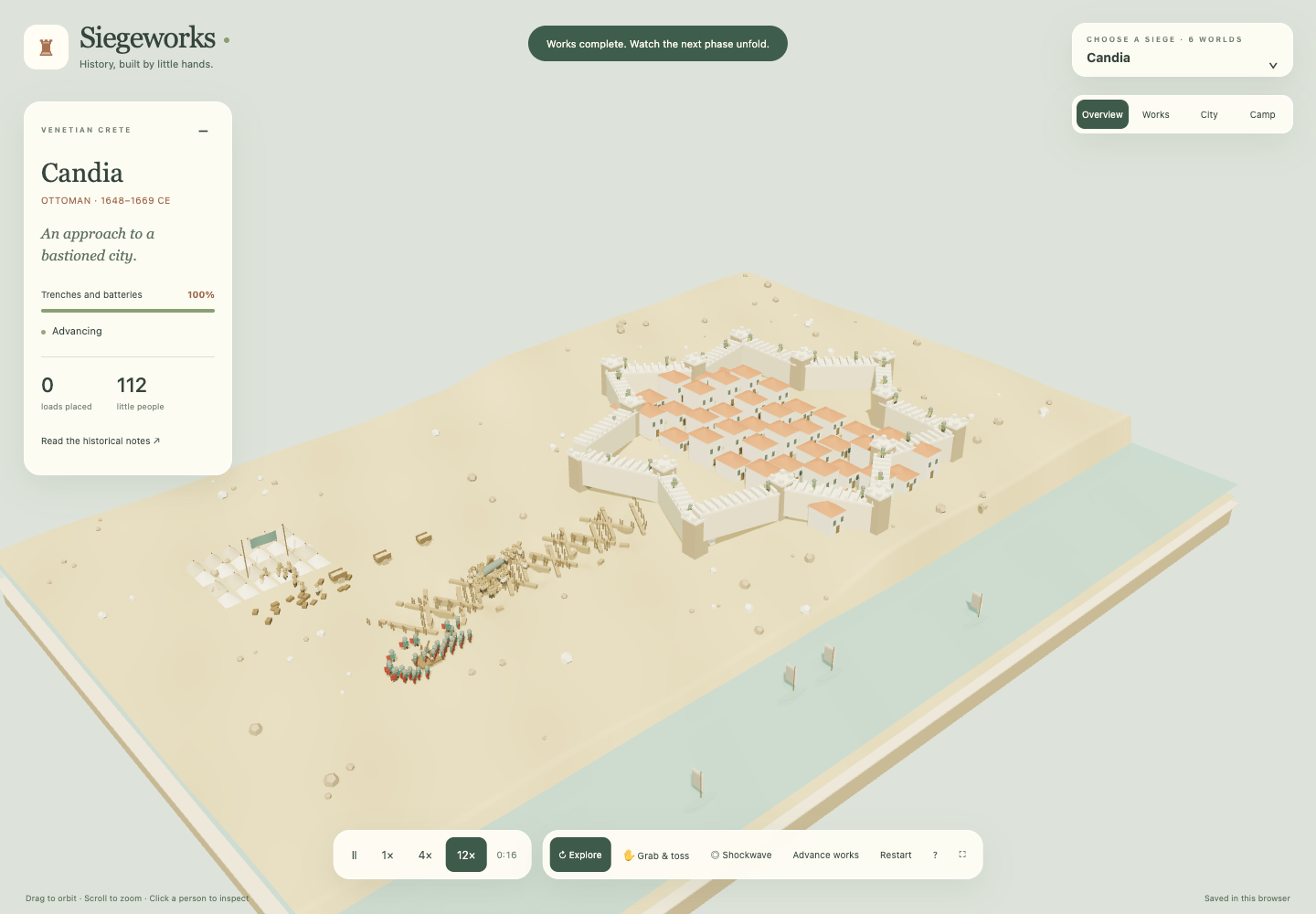
Ottoman / 1648–1669 CE
Digging crews push zigzag trenches toward the Venetian bastions. Supply carriers move between the camp and batteries while cannon exchange fire over the earthworks.