BROWSER / NO INSTALL
Look around first
Explore published scroll geometry in Unroll. Then try the official ink-labeling and surface-tracing exercises. Your first goal is to distinguish a CT slice, a traced surface and an ink prediction.

VESUVIUS CHALLENGE / RESEARCH & OPEN SOFTWARE
The Vesuvius Challenge brings scanning, geometry, machine learning and papyrology together to recover text from carbonized scrolls. Our contribution is software for exploring that process, testing its outputs and making the evidence easier to inspect.
This collection presents public engineering work and measured comparisons. It does not announce a new scroll reading, title identification or prize result.
The Herculaneum papyri were carbonized in the eruption of Vesuvius in AD 79. Fragile, compressed layers make physical opening destructive. Virtual unwrapping works from X-ray computed tomography (CT), but a scan is only the beginning. The official introduction explains the challenge and provides interactive exercises.
CT produces a three-dimensional grid of voxels. Orthogonal slices help locate papyrus layers. A crop needs a known sample, axis order and voxel size; a full scroll can occupy terabytes.
Segmentation traces a papyrus surface through that volume. A trace can jump to a neighboring layer or cross itself. Inspect it in several CT views before making it larger.
A surface is flattened and sampled along its normal to form a surface volume: a thin stack of layers around the sheet. Its depth axis, orientation and physical scale matter downstream.
An ink model or image filter produces a two-dimensional score map. Fibers, cracks and geometry can also make patterns. Compare with known labels and a suitable negative control.
A text reader can suggest letters from an existing image. Supplied lines and letter height simplify the problem; automatic layout is harder. A plausible word is not evidence by itself.
Papyrologists assess legibility, language and context against the image evidence. Software confidence and successful execution do not certify an interpretation.
BROWSER / NO INSTALL
Explore published scroll geometry in Unroll. Then try the official ink-labeling and surface-tracing exercises. Your first goal is to distinguish a CT slice, a traced surface and an ink prediction.
OFFLINE / KNOWN ANSWER
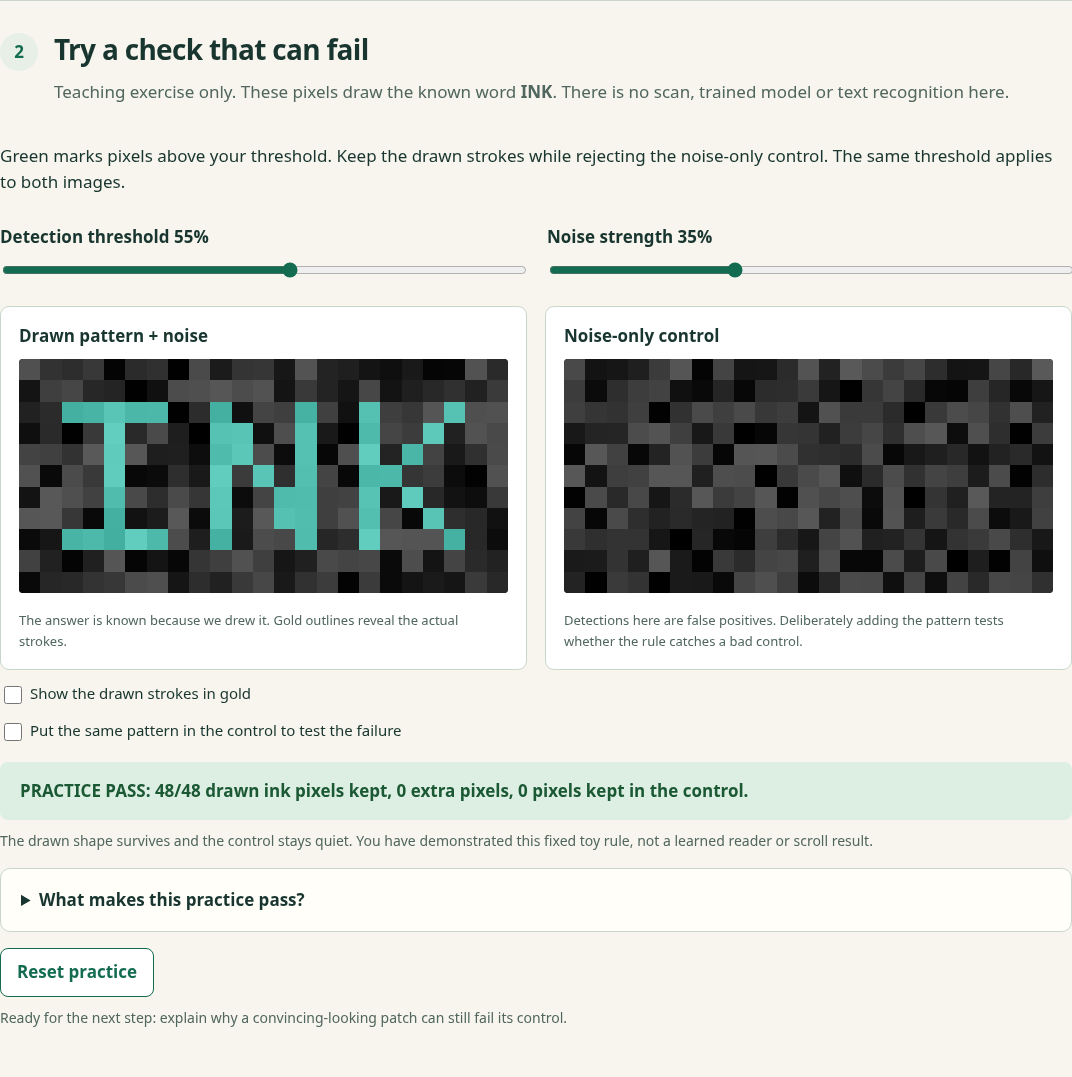
Download Scrolls Starter and open it in a browser. Move a threshold over a drawn INK pattern, then put the same pattern into its control. The exercise should change to PRACTICE FAIL. No Python, GPU or account is needed.
OFFICIAL DATA / ONE CROP
The official Get to Know a Dataset notebook introduces metadata and a bounded crop. Read cells before running them, check the data terms, use CPU for this first inspection and stop after the small example. Our walkthrough explains axes and memory.
OFFICIAL TOOLS / ONE TASK
Use the official VC3D tutorial to navigate a sample and follow a sheet. The ink-detection tutorial comes next. Our tools are optional: you can use the official workflow directly.
For installation, use the single Start Here guide, with macOS, Windows and Linux commands, expected results and troubleshooting. The picture guide shows the actual screens. Starter itself never downloads scans, runs inference, rents compute or uploads files; its optional command builder prepares a command for you to inspect and run.
Unroll, Scroll Lens and Starter provide different ways to explore. Workbench collects small command-line tools; it is not one large application window. Browser exploration, hosted inference and local CPU processing have different requirements.
Choose a tool by taskInkfilter publishes a frozen numerical recipe and saved-score evidence. Scroll Text Reader records its model and controls. AutoPipeline coordinates stages and retains their outputs. Their limits are part of the documentation.
What the measurements supportPublic sources reviewed 18 October 2026. Hendrick Research is an independent contributor, not the organizer of the Vesuvius Challenge. Software, models and datasets have separate licenses. Public source and corrections. Screenshot sources and hashes.